
How to Monetize Your Substack Intelligently (Without Burning Out)
The inner revenue system, and 3 frameworks to practice with

When I started my newsletter, I was drawn to creators who made money look easy.
People who could casually mention “$50K months” in a post. Who launched offers and sold out in 24 hours. Who seemed to have unlocked some secret formula that turned everything they touched into revenue.
Most of the time, I didn’t understand how they were actually doing it (because either I was too inexperienced or they overcomplicated everything they said), but since it sounded successful and systematic, I paid attention anyway and gave them my respect.
The thing is, I never thought I could do the same.
I thought these people were inherently better at business than I was.
I didn’t think my brain had the capacity to monetize without feeling “salesy.” I was good at creating content and building trust, but turning that into consistent revenue felt like a completely different skill.
I felt like I had to learn entire marketing frameworks and memorize every sales tactic so I could execute them perfectly, because that’s what I saw everyone else doing.
But now, 14 months later, and without really trying to become a “sales expert”... people ask me how I monetize so effectively.
Over the past year, 70,000 people have chosen to hit the subscribe button on my Substack. I’m not a marketing guru. I’m not that strategic either. I’m actually quite simple in my approach (which I like). I wouldn’t even say that my monetization is revolutionary or complex.
I can, however, attribute most of my success ($240,000 in 14 months) to being able to monetize in a way that feels natural—not forced.
And... It’s not that difficult to do.
So, maybe you’re a new creator who wants to make money from your newsletter. Maybe you’re launching an offer and don’t want to sound desperate (because you’re scared nobody will buy). Maybe you want to command premium prices without feeling “salesy.” Or, maybe you just want to build a business that doesn’t burn you out.
I’ve come up with 3 methods to monetize your newsletter intelligently, and I’ve ordered them from beginner to advanced. These are what I use when it’s time to launch an offer or write a promotional post. I’ve also included a few resources to help with this at the very end.
But there’s something more important that must come before.
First, we need to build your inner revenue system.
The Inner Revenue System
If you want to monetize your newsletter intelligently, you need a core set of 5-7 monetization principles that guide every offer decision. Then, when it’s time to launch something new, you have a foundation you’ve already thought through hundreds of times before.
I’ve been getting invited to speak on more podcasts about newsletter monetization.
But these conversations are much, much different than the ones I had as a beginner.
There’s a lot on the line. These podcasters have built audiences of hundreds of thousands. It’s nerve-racking. And since so many people will listen, I feel responsible for providing as much value as I possibly can.
I’m not the best at articulating monetization strategy yet.
When I listen back to episodes, I’m always kicking myself about how I could have explained something better.
And that leads to the problem.
I’ve launched dozens of offers.
Generated $240,000 in revenue in 14 months.
My 2hrs/day biz made $247,347 this year (feel free to copy the system)

This year, my tiny one-person writing business generated over $240,000. (and no, I’m not gonna show you my stripe screen shot for it, no need).
Written hundreds of articles about monetization.
It’s obvious to me which principles are the most valuable. It’s obvious which frameworks have led to the most revenue or the most success for my students. It’s obvious that I really only have 5-7 core monetization beliefs that represent my brand and the value I can provide.
Those are the principles people want to hear.
Those are the principles that introduce new readers to how I think about business.
But here’s my biggest mental hurdle... I don’t want to sound like I’m repeating myself.
So when I get on a podcast, or am asked to speak about monetization, I avoid saying the things I’ve already said well. My mind goes blank and I have to force something new out to avoid sounding repetitive.
I want to somehow come up with this groundbreaking monetization hack on the spot, when I know that’s not how business works. Good monetization strategies require time to test and refine.
But here’s what I’ve learned:
The best monetization minds—people like Alex Hormozi, Russell Brunson, Chris Do, Jenna Kutcher (who is now on Substack too, :o) - don’t come up with new frameworks every time they speak.
They have their “greatest hits.”
Their core principles that they repeat over and over.
Because the most important ideas deserve to be repeated.
And if you don’t have a body of work around monetization—real offers you’ve launched, real revenue you’ve generated, real systems you’ve tested—you may want to adjust your expectations as to the work you have ahead of you.
Now, why do you listen to your favorite business educator?
Because they have a specific philosophy or approach that resonates with you. Most of their content reinforces the same core principles with slight variations here and there. You can read a few sentences and know exactly whose framework it is.
If someone who teaches “hustle culture” suddenly switched to teaching “work 2 hours a day,” their first piece of content would feel inauthentic, and most of their audience would not like it.
The same applies to being a newsletter creator who wants to monetize intelligently.
You need to launch offers, test strategies, and analyze results—hundreds of times—until your core monetization principles are obvious. By nature, you must repeat yourself, because the most important principles deserve to be repeated, and how else are you going to refine them?
You can think of these core principles as your “monetization mantras.”
In my business, I have a few topics I talk about frequently: the One Offer System (which is what I show in the Build to Profit program), the 2-Hour Operating System, the Anti-Sell Method, The Stewardship Principle, etc.
For each of those frameworks, I have a few core beliefs that guide every decision.
When I think about it, the best monetization educators don’t answer questions about “how to make money” with generic advice.
They don’t say, “Well, just create an offer and launch it.”
Instead, they speak their strongest principle with confidence, then expand on it with supporting evidence. Not only does this build trust with the audience, but it also positions them as having a unique methodology.
Here’s an example:
If someone asked me, “What’s the most important thing for newsletter monetization?”
I could just say “build trust first” or “create valuable content,” but I understand there are levels to this, so I would respond with one of my core principles:
“The Stewardship Principle: People buy from those they trust to serve, not sell.”
Not only is that something the audience wouldn’t expect (because most monetization advice is tactical, not philosophical), but it sets up an interesting conversation about why ethical monetization works better than aggressive tactics.
And it’s a principle I’ve proven with real results—$240K in 14 months without hard closes, fake scarcity, or manipulative tactics.
Makes sense, but how do we actually practice this, from beginner to advanced?
What This Post Will Show You
This isn’t generic “how to monetize” advice.
This is the exact inner revenue system I use to guide every monetization decision—with 3 frameworks you can implement immediately.
Part 1: The Inner Revenue System
My 7 core monetization principles:
The Stewardship Principle (serve, not sell)
The One Offer System (3 offers > 9 offers)
The Trust Floor (baseline recurring revenue)
The Anti-Sell Method (get thanked for saying no)
The 2-Hour Rule (if it takes more than 2 hours/day, eliminate it)
The Asset Over Cash Principle (never sell the goose)
The Freedom Over Fortune Filter (does this give or take freedom?)
Part 2: 3 Monetization Frameworks (Beginner to Advanced)
Beginner: The Trust Floor (How to build baseline recurring revenue)
Intermediate: The Product Ladder (How to scale to $50K-$100K/year)
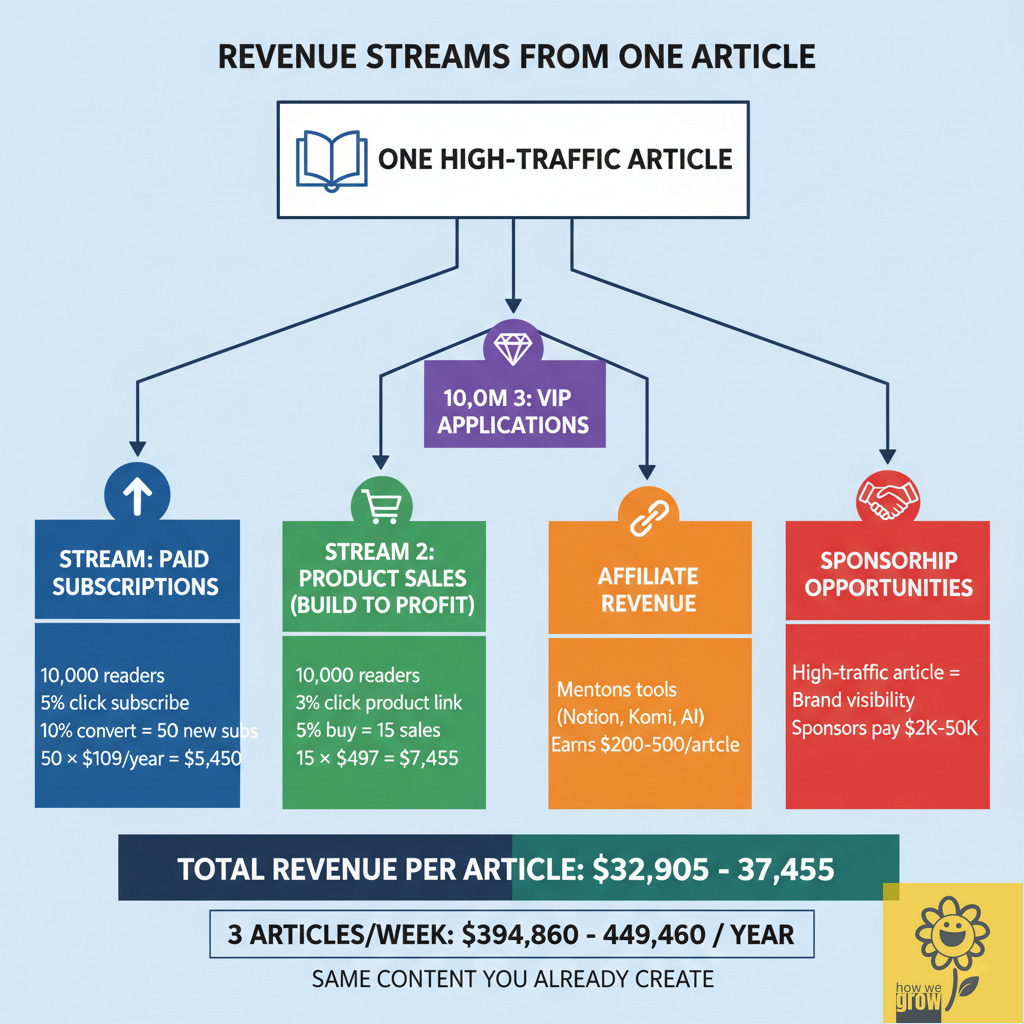
Advanced: The Asset Stacking Method (How one piece of content generates 5 income streams)
Part 3: The Monetization “Legos”
The modular pieces you can use to build any offer:
The Transformation Promise
The Value Stack
The Friction Remover
The Social Proof Element
The Scarcity Trigger (real, not fake)
The Bonus Positioning
The Risk Reversal
This is how I think about monetization.
With real principles.
With tested frameworks.
With the exact systems I use every single day.
