

Why the most profitable Substack creators in 2026 will be storytellers, not strategists
and what this means for your content calendar full of ‘how-to’ posts

I’ve been doing some serious reflecting on this absolute rollercoaster of a year building my newsletter from 0 to 71,000 subscribers. And can I just say? The rules have completely changed.
If you’re feeling like your perfectly planned content calendar isn’t converting subscribers into buyers, you’re not alone. Your analytics look good. Your open rates are decent. You’re consistent. You’re providing value. And yet... crickets when you ask for money.
(BTW, in case you haven’t already, you might wanna join me next Tuesday, Live.)
But I know you already know this. You’re living it. You’re feeling it. So the real question isn’t “Am I doing something wrong?”, it’s “What changed and how do I adapt to actually make money in 2026?”
Well, buckle up, because what I’m about to share is going to completely flip how you think about your entire newsletter strategy.
Welcome to The Story Economy
That’s right. We’re not in the ‘how-to’ content era anymore. We’re not even in the value-stacking era. We’ve officially entered what I’m calling The Story Economy, and the creators who understand this shift are about to have their best revenue year ever.
Let me break down what’s really happening right now, because once you see it, you can’t unsee it.
First, AI has completely commoditized strategy. Anyone can hop on ChatGPT and get a personalized business plan, content calendar, growth strategy, complete with frameworks and step-by-step instructions. The “how-to” content you spent hours researching and organizing? ChatGPT can generate it in 30 seconds. That strategic framework you worked so hard to develop? It’s now available to anyone with an internet connection, instantly, for free.
Second, we’re drowning in strategies but starving for connection. Your ideal subscribers have consumed endless tactical content. They’ve saved 47 “ultimate guides.” They’ve bookmarked 200+ LinkedIn posts with frameworks. They’ve screenshot your threads. And yet—they’re still stuck. Still not executing. Still feeling alone.
Third, people are exhausted from being taught at. More frameworks. More systems. More “5 steps to X.” More strategies that sound smart but feel... empty. Like eating a meal that looks Instagram-perfect but tastes like cardboard.
Everyone’s optimizing content, but very few creators are making readers actually feel something.
And most of all, we’re all tired of performative expertise. The polished posts. The “I have it all figured out” energy. The guru vibes. It’s exhausting to read and it’s definitely exhausting to write.
So what does all this mean for your Substack and how you should position yourself in 2026?
The Big Shift (and why it matters)
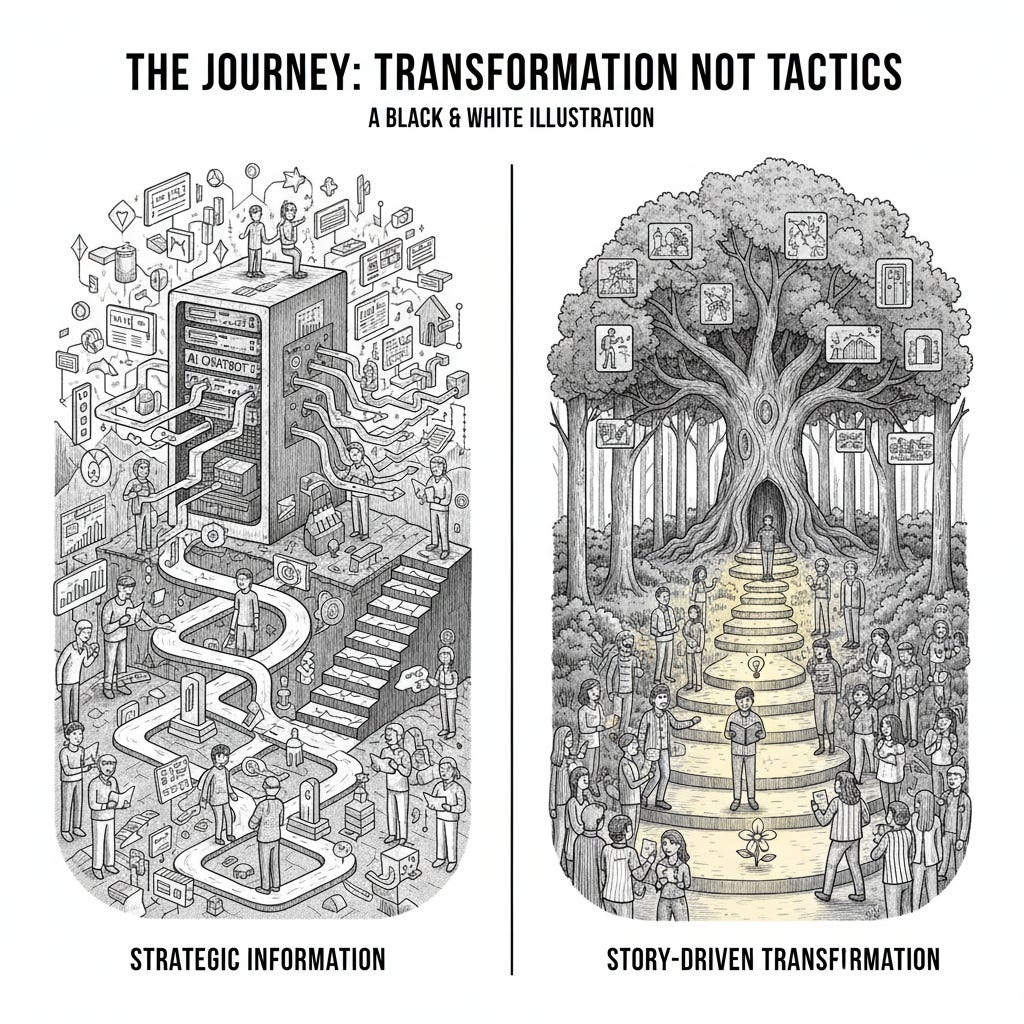
Here’s what I want you to really get: Since ChatGPT can give people all the strategies and teach them all the frameworks, and since we’re collectively overwhelmed with consuming more tactics, what people are actually craving, and what they’re willing to pay for, is story-driven transformation, not strategic information.
Think about it…
The newsletter creators making $10K-$25K/month? They’re not the ones with the most polished frameworks or the best “ultimate guides.”
They’re the ones telling stories that make you think: “Holy shit, that’s exactly how I feel. I thought I was the only one.”
They don’t write “7 Steps to Build a Business.” They write “I almost priced my offer at $47 and it would’ve cost me $7,448. Here’s what happened at 11:47 PM when I was lying in bed feeling sick about it.”

STORY. Not strategy.
Look at every Substack bestseller. They’re not teaching better than ChatGPT. They’re being more human than ChatGPT ever could.
They understand that humans don’t subscribe to newsletters for information. We can Google search that with Perplexity AI. We subscribe because we want to feel less alone. We want someone to articulate what we’re experiencing. We want proof that someone else gets it.
The pattern is clear. And yet, so many newsletter creators are still stuck in the old paradigm, positioning themselves as experts sharing strategies rather than humans sharing stories.
What this means for your newsletter in 2026
In The Story Economy, the creators who will absolutely dominate—the ones getting paid subscribers, selling out offers, building communities people can’t leave—aren’t the ones with the most comprehensive guides.
They’re the ones with the most honest stories.
If you’re a business newsletter, you’re not sharing “5 productivity hacks.” You’re telling the story of the Tuesday morning you realized your carefully planned week was bullshit and you threw it all away to launch an offer in 48 hours that made $4,200.
If you’re a parenting newsletter, you’re not listing “10 tips for bedtime routines.” You’re describing the 3 AM moment you sat on the bathroom floor crying because you yelled at your kid again, and what you learned about yourself in that moment.
If you’re a career newsletter, you’re not teaching “How to negotiate salary.” You’re sharing the exact conversation you had with your boss at 2:47 PM on a Thursday when you finally asked for what you were worth—including the part where your voice shook and you almost chickened out.
The creators who will dominate in 2026 understand that readers don’t have an information problem. They have a connection problem. And no amount of strategic content will solve loneliness.
This is the future. Actually, scratch that. This is the present. And the creators getting all the paid subscriptions already know this.
“But I’ve built my whole brand on being the expert!”
I know what you’re thinking: “But Ana, I’ve spent years building credibility. My whole brand is about being knowledgeable. Won’t storytelling make me look less professional?”
Here’s my view: Your expertise isn’t going anywhere. But expertise without story is forgettable.
I learned this the hard way.
In my first 3 months building my newsletter, I wrote “strategic” content. Clean frameworks. Organized systems. Professional as hell.
Know how much I made? $1,200.
Then I wrote about fainting in a hotel bathroom at 3 AM after getting promoted to senior VP. About lying in bed at 11:47 PM scared to price my offer at $497. About going bankrupt three times and laughing by the third one.
Revenue in the next 3 months? $22,000.
Same expertise. Same knowledge. Different packaging.
Your expertise is your foundation. Your credibility. Your authority. But story is what makes people pull out their credit cards.
People trust experts. But they pay storytellers.
The psychology behind why this works
Here’s what neuroscience tells us about how humans actually make decisions:
We don’t buy based on logic. We buy based on emotion, then justify with logic.
When you share a strategy, you activate the logical brain. People think: “That makes sense. I should do that.”
Then they close the tab and never think about it again.
When you share a story, you activate the limbic system—the part of the brain that processes emotion, memory, and connection.
People feel: “Oh my god, that’s me. I’m not alone. If they figured this out, maybe I can too.”
THAT’S when they subscribe. That’s when they upgrade to paid. That’s when they buy your offers.
Because you’re not just teaching them something. You’re making them feel something.
And humans will pay a premium to not feel alone.
Think about the last thing you bought from a creator.
I’ll bet money it wasn’t because they had the most comprehensive guide.
It was because they told a story that made you think: “This person gets me.”
I’m making this shift in real-time...
I’m making this exact shift myself, and I want to be totally transparent about what’s changing.
I caught myself still writing “strategic” posts. Still organizing content around frameworks. Still trying to be the “expert” who has it all figured out.
That’s not who I am.
I’m a mom who works 2 hours/day while my baby naps.
I’m someone who quit a senior VP job after fainting in a hotel bathroom.
I’ve gone bankrupt three times and rebuilt every time.
I’ve lived in 50+ cities and never owned a home.
I almost didn’t launch my first offer because I was scared to charge $497.
THOSE stories? Those are what make people buy.
Not my “5-step framework for offer positioning.”
But the story of lying in bed at 11:47 PM, texting my friend, almost pricing myself out of $7,448 because I was scared.
When I share THAT story, people message me: “I’m doing the exact same thing right now with my pricing. Thank you.”
And then they buy my $497 program.
Story sells. Strategy educates.
I want to educate AND sell. So I’m leaning all the way into story.
This is the shift I’m inviting you into as we move into 2026.
How to make this shift (without losing your credibility)
Stop asking yourself “What valuable content can I share?” and start asking “What story from my life illustrates this lesson?“
Your expertise is the lesson. Your story is the delivery mechanism.
Your knowledge creates trust. But story creates buyers.
Here’s the formula I use now:
